|
 |
|
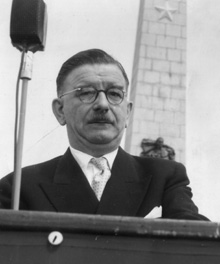
| Chancellor Leopold Figl at the memorial to victims at Mauthausen concentration camp. | |
|
|
|
Politically relevant texts always have an "advocatory function," because it is a law of political argumentation that "where an existing text is available, the most favorable statements will be taken up and emphasized," while those that are less favorable are at the very least "underexposed," Stourzh writes. "It was out of the question for the Austrian government to reject the opportunity presented by the Allies in the first part of the Moscow Declaration." (p. 26) Put in less scholarly terms, one could hypothetically pose the question as to whether Leopold Figl, who suffered in Dachau concentration camp from 1938 to 1943 and in Mauthausen from 1944 to 1945, and was a member of the provisional Renner government from its inception, finally succeeding Renner as chancellor after the elections in November 1945, should have proclaimed to the world: "The Allies have made a mistake: we Austrians are cheats, we were not victims but National Socialist perpetrators, so do not treat us any better than the Germans!"?
Figl's first government consisted of representatives of the People's Party and the Socialist (now the Social Democratic) Party. On average, it had 17 members, twelve to fourteen of whom had been victims of National Socialist persecution, and some of whom had also been imprisoned in concentration camps. In 1948, Figl announced at a cabinet meeting that he would take part in a memorial service for a Russian general who had been murdered at Mauthausen concentration camp: "He was imprisoned two cells away from me." It was also Figl who in the final phase of the negotiations for an Austrian State Treaty pressed for the deletion of a passage concerning "Austria's complicity." However, at the inter-governmental round of negotiations in Moscow in April 1955, he was unable to overcome Soviet resistance. It was only at the last conference of foreign ministers in Vienna on May 14, 1955, one day before the signing of the treaty, that he was able to push it through. Once again, as when the Moscow Declaration had been formulated twelve years earlier, Molotov was foreign minister. And Figl recalled—to the horror of Austrian witnesses—how he had heard the voice of Vyacheslav Mikhailovich Molotov over the loudspeakers of Dachau concentration camp when Molotov and the German Foreign Minister Joachim von Ribbentrop signed the German-Soviet non-aggression pact in summer 1939. However, Molotov did not explode and the clause about Austrian complicity was stricken from the State Treaty.
Gerald Stourzh also provides yet more proof of the importance of the Allied declaration that Austria had been a victim of Hitler's expansionist policy. In the years following the end of National Socialist rule, this categorization had greatly supported efforts to emphasize the "Austrian" over the "German." The promotion of a separate Austrian national feeling, perhaps sometimes even a little too strenuously, certainly decisively strengthened the will to national independence and autonomy. If Austria had rejected this status as a liberated country for itself, it would have been one of three states to emerge from the ruins of the German Reich and—in a logical continuation of this interpretation—would have had to choose membership in either the Western or the Eastern military alliance (or would have been forced to join one of the two or might even have been partitioned). After the end of World War II and before the intensification of the Cold War, no one was able to foresee how the future would develop. By taking this decision, the position adopted by Austria was not only advantageous; to some degree it was also risky.
|
|
